
Clearwater County Criminal Court Records
A criminal court record is the case file maintained once a charge is filed in court. In Clearwater County, that file is held through the District Court and Magistrate Division system, with local clerk handling at the courthouse in Orofino. The file can include the complaint or information, probable cause material when public, arraignment entries, bond orders, plea papers, motions, hearing minutes, orders, disposition, sentencing, fines, restitution, probation conditions, and warrants or failure-to-appear notices.
Felony cases commonly begin with arrest or complaint and preliminary proceedings in magistrate court, then move to District Court after bind-over or indictment. Misdemeanor cases generally remain in the Magistrate Division. The prosecutor files or declines charges after reviewing law-enforcement reports, while the court record shows what the judge and clerk docket after filing. For the narrower filed-charge path, use the Clearwater County court charge records page.
The assigned prosecutor image comes from the Clearwater County Prosecutor, the local charging office identified in the research.
That office is important to the court file because the sheriff may arrest or book a person, but the prosecutor's filed complaint or information creates the court charge record.
Search Clearwater Criminal Court Records
The main online search channel is the Idaho iCourt Portal / Odyssey public access system. It is statewide, so search results should be narrowed by Clearwater County, Orofino, or Second Judicial District filters when the portal offers them. Public criminal results may show case metadata and docket entries, but document images, sealed filings, affidavits, exhibits, transcripts, and certified copies may require clerk handling.
- Open iCourt and choose the public search option available without attorney credentials.
- Search by defendant name or full criminal case number.
- Use court, location, case type, and date filters to narrow statewide results to Clearwater County when possible.
- Open the result and read the docket for charges, arraignment, plea, hearings, disposition, sentence, and warrant status.
- Contact the Clerk of the District Court for certified copies, older files, uncertain case numbers, or documents not available online.
Criminal-history records are not the same as criminal court files. Idaho Code section 67-3004 governs dissemination of criminal history record information, while iCourt shows court case activity that is public under court access rules. Sentenced state custody or supervision is also separate and may be checked through the Idaho Department of Correction resident/client search.
Clearwater Criminal Case Flow
A criminal case file grows as the case moves from accusation to final outcome. Each step can create a docket entry or document. The prosecutor's charging decision starts the court case, the judge handles appearances and rulings, and the clerk records filings, hearings, orders, financial obligations, and case status.
Case flow: Charges Filed › Arraignment › Pretrial / Motions › Plea or Trial › Disposition › Sentencing
| Stage | What Happens |
|---|---|
| Charges filed | The prosecutor files a complaint or information, or an indictment is returned in the proper case. |
| Arraignment | The defendant is advised of charges and enters a plea such as guilty or not guilty. |
| Pretrial / motions | The parties file requests, argue evidence, address bond, and prepare for plea or trial. |
| Plea or trial | The case resolves by plea, trial verdict, dismissal, amendment, or other court action. |
| Disposition | The docket records the final outcome of each charge or case. |
| Sentencing | The court imposes jail, prison, probation, fines, costs, restitution, or other conditions if there is a conviction. |
What Clearwater Criminal Records Show
A Clearwater County criminal court record may show a full chain of court activity, but public search can be limited to metadata. Some documents may be available only from the clerk, and some may be sealed or redacted. Use the case number when asking for copies, since party-name searches can return similar cases across Idaho.
| Field | What It Shows |
|---|---|
| Case number | The unique criminal case identifier used for docket search and clerk copy requests. |
| Defendant | The person charged, subject to redaction or restriction in protected cases. |
| Court location | Clearwater County, Second Judicial District, District Court, or Magistrate Division. |
| Charges | Filed offense, statute reference when shown, severity, amendment, dismissal, or reduction history. |
| Prosecutor action | Complaint, information, plea negotiation, dismissal, amendment, or other charging action. |
| Plea | The defendant's formal response, such as guilty or not guilty. |
| Hearings | Dates, times, hearing type, judge or magistrate, and result when public. |
| Disposition | Final charge outcome, including guilty, not guilty, dismissed, acquitted, or other final result. |
| Sentence | Jail, prison, probation, fines, court costs, restitution, and conditions when imposed. |
| Warrant / bond events | Bond orders, failure-to-appear events, bench warrants, recall, quash, or served status where public. |
Charges vs Convictions
Being charged is not the same as being convicted. A Clearwater County criminal court record can show a filed accusation that was later amended, reduced, dropped, dismissed, or resolved by acquittal. Read each charge line with its disposition and sentence field before treating it as a conviction.
| Point | Charge | Conviction |
|---|---|---|
| Meaning | An allegation filed in court by the prosecutor. | A final result after guilty plea, trial verdict, or other qualifying finding. |
| Where it appears | Complaint, information, indictment, charge line, and early docket entries. | Disposition, judgment, sentencing order, and final docket entries. |
| Can change | May be amended, reduced, dismissed, or dropped. | May later be affected by appeal, relief, or qualifying dismissal procedure. |
| How to read it | Check the statute, degree, filing date, and charge status. | Check the final disposition and sentence for that specific count. |
Clearwater Dispositions and Sentences
Disposition means the final outcome of a charge or case. A docket may show guilty, not guilty, dismissed with prejudice, dismissed without prejudice, acquitted, deferred or withheld judgment language, or other court action. Dismissed with prejudice means the charge cannot be refiled. Dismissed without prejudice means refiling may be allowed if law permits it.
Sentence means the punishment or conditions imposed after conviction. A criminal court record can list jail or prison time, probation, fines, court costs, restitution, payment plans, bond forfeiture, no-contact terms, treatment conditions, or other orders. Financials can include fines, costs, restitution, and bond information, but public metadata does not guarantee that every financial image or receipt is online.
Note: Read disposition and sentence fields by count, since one case can include more than one charge.
Sealed vs Expunged Records
Idaho criminal-record relief should be described with care. The research identifies Idaho Code section 19-2604 as a dismissal and relief path for some qualifying defendants after probation or sentence conditions are satisfied. That does not mean every criminal record is erased. Court access, public search, law-enforcement access, and agency dissemination can differ.
| Point | Sealed | Expunged / Relief Language |
|---|---|---|
| Public visibility | Removed from ordinary public access by rule or court order. | May reduce public display or legal consequences when a statute applies. |
| Record existence | The court or agency may still retain the record. | Do not assume destruction unless the specific law says so. |
| Examples | Sealed filing, sealed warrant, sealed affidavit, juvenile or protected matter. | Dismissal after probation or sentence relief under qualifying Idaho procedures. |
| How to request | Ask the court about party status, eligibility, and court-order requirements. | File in the court where the case was handled and cite the statutory basis. |
Public Criminal Court Access
Public access to Clearwater County criminal court records begins with Idaho court access rules. Idaho Court Administrative Rule 32 governs access to judicial records. For county agency records outside the case file, the general Idaho public-records framework includes Idaho Code section 74-102 for the right to examine and copy public records, section 74-103 for response timing and fees, and section 74-105 for exemptions.
The sheriff image assigned to this page comes from the Clearwater County Sheriff's Office, which is a separate source for jail, custody, law-enforcement, and warrant-related records.
The sheriff may hold booking or law-enforcement records, while the court clerk holds the criminal case file. Those channels can overlap in one event, but they are not the same record system.
Criminal Records and Custody
A criminal court record may lead to custody, probation, fines, restitution, or another sentence, but custody records are held by different offices. Jail booking and local custody questions route to the sheriff. Sentenced state custody and supervision may appear in the Idaho Department of Correction resident/client search. A court disposition should be checked against the custody source when the question is where a person is now, not what the court ordered.
The assigned state-custody image comes from the Idaho Department of Correction resident/client search.
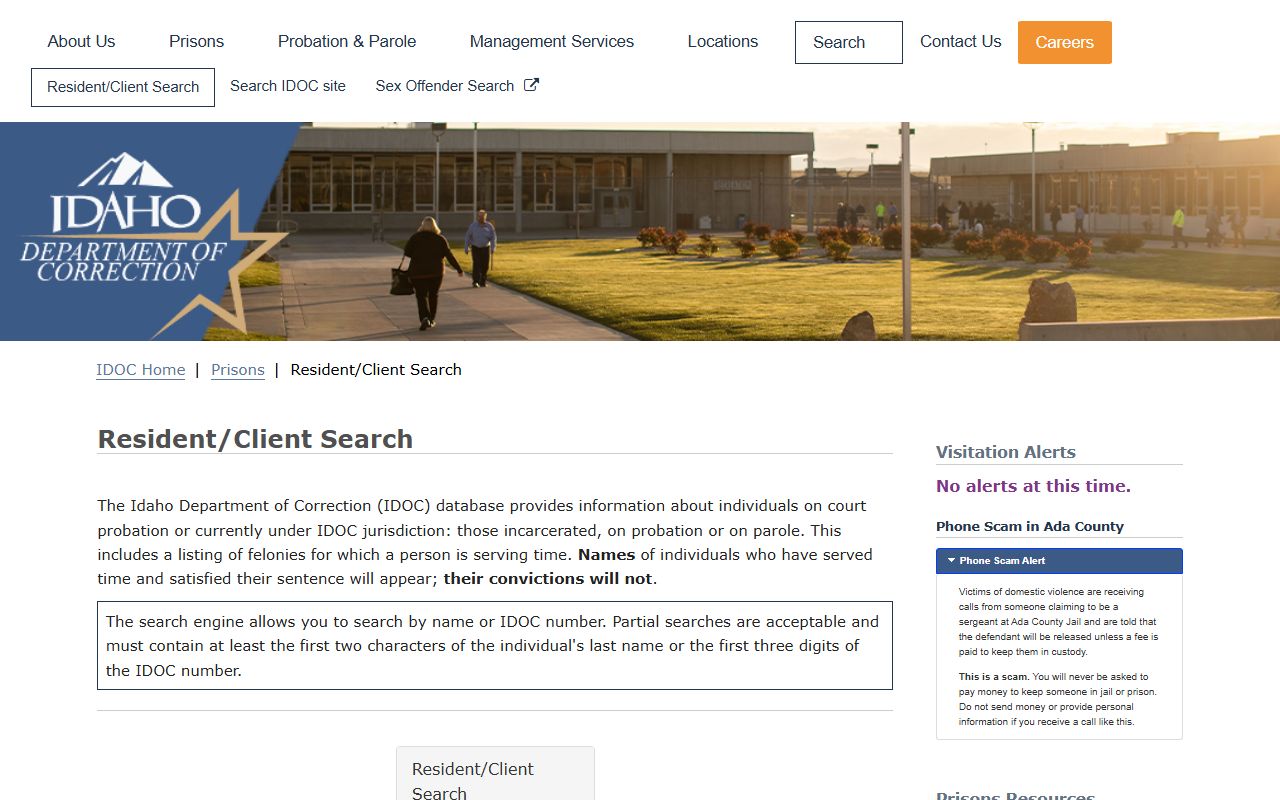
Use IDOC for sentenced state custody or supervision, and use iCourt and the clerk for the filed criminal case record.
Restricted Clearwater Criminal Records
Restricted criminal court records include sealed cases, sealed filings, sealed warrants, sealed affidavits, juvenile proceedings, mental-health-related records, protected personal identifiers, protected addresses, minor names, medical details, and other information withheld by rule or court order. Public search may show a limited docket line, redacted information, or no visible case at all.
A person seeking to limit public access should identify the exact case number and disposition first. Eligibility depends on the conviction, sentence, probation result, waiting period, prior record, and statute. A petition normally returns to the court where the case was filed, so a Clearwater County case routes through the Clerk of the District Court. The request should identify the case, requested relief, statutory basis, and prosecutor service if required.
Clearwater County Clerk of the District Court
150 Michigan Avenue
Orofino, ID 83544
Confirm current phone on the official clerk page
Confirm hours before visiting