
Clearwater County Arrest Records and Charges
Clearwater County arrest records start on the sheriff and jail side of the process. They may reflect an arrest, booking, custody status, release, bond information, or a law-enforcement event. The official local starting point for arrest and jail questions is the Clearwater County Sheriff's Office. The county also links custody users to VINE and VINELink when a person needs notice of custody changes.
A court charge record is narrower and more formal. It identifies the offense filed in court, the statute or charge text, the level of the charge, the plea, and the charge status. The Clearwater County Prosecutor reviews law-enforcement reports and files or declines charges for the state or county. That means an arrest can lead to no charge, one charge, several charges, or a later amended charge. For jail custody and booking detail, use the Clearwater County inmate records path. For the full criminal case file, motions, disposition, and sentence, use the criminal case record.
The Idaho State Police sex offender registry is one statewide record source tied to certain convictions and registration duties. The registry image assigned for Clearwater County arrest and charge research comes from the Idaho State Police sex offender registry.
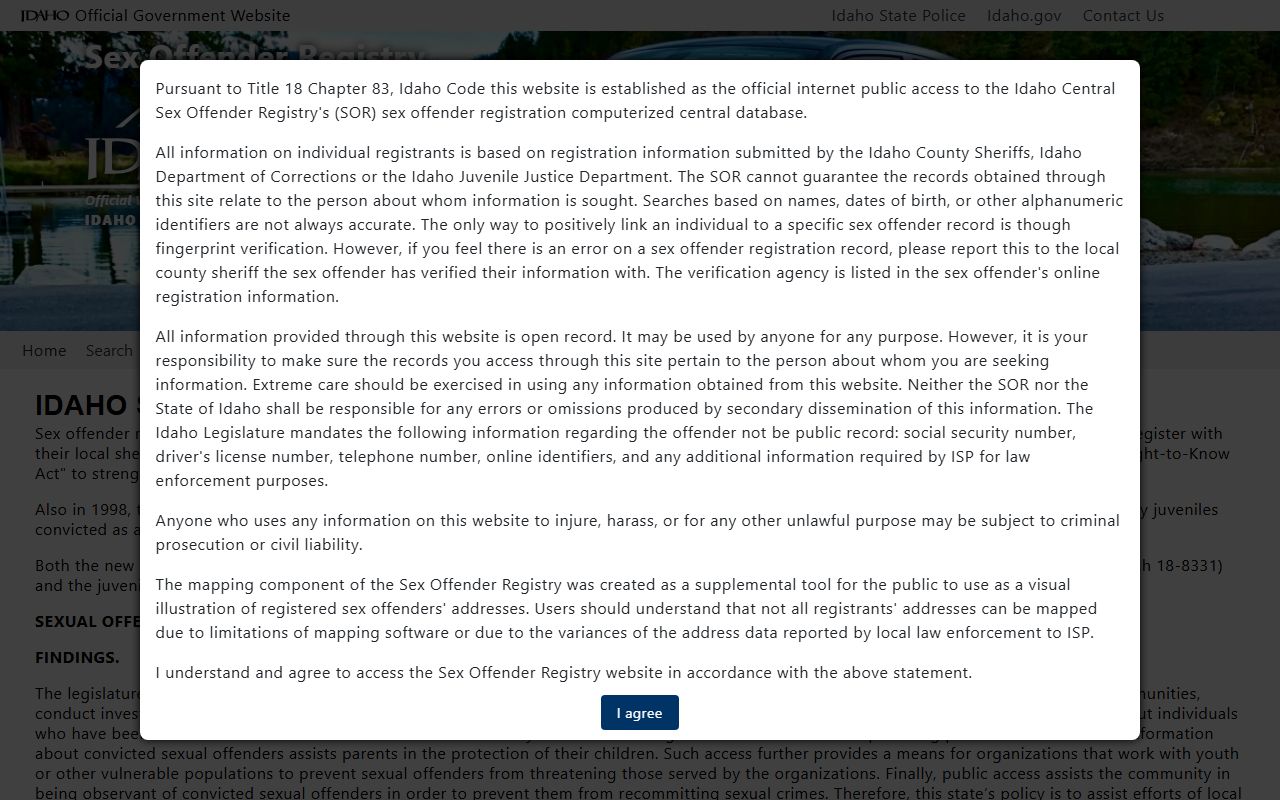
Registry results are not a substitute for a Clearwater County charge record because registry status depends on a separate legal duty after qualifying offenses.
Search Clearwater County Arrest Records
Clearwater County did not publish a separate county-only court charge database in the research sources. The official public case search channel is the Idaho iCourt Portal / Odyssey public access system. Use iCourt for District Court and Magistrate Court charge records, then contact the Clerk of the District Court in Orofino for older files, certified copies, documents not shown online, or cases that appear incomplete.
- Start with the Idaho iCourt Portal and choose the public search option available without attorney credentials.
- Search by full case number if known. If not, search by last name and first name, then narrow to Clearwater County or the Second Judicial District if that filter appears.
- Open the criminal, misdemeanor, traffic, or infraction case and read each filed charge, event, hearing, bond, and disposition entry.
- Compare charge entries with any custody or booking status from the sheriff, VINE, or jail contact channel.
- Ask the Clerk of the District Court for copy options when the portal shows metadata but not the filed document image.
The county's custody notification image assigned to this topic comes from VINELink, which is useful when arrest records lead to a custody-status question rather than a court-file question.
VINELink can help with custody notice, but pleas, amended charges, dismissals, and sentences should be verified against the court case record.
Clearwater County Court Charge Documents
The court charge record starts when the charging document reaches the court file. Idaho criminal records in Clearwater County can include a complaint, information, probable cause material when public, arraignment events, plea entries, orders, disposition, sentence, fines, restitution, probation conditions, and warrant events. Felonies often begin in magistrate proceedings, then move to District Court after bind-over. Misdemeanors generally remain in the magistrate division.
| Document | Who Creates It | What It Does | Clearwater County Use |
|---|---|---|---|
| Complaint | Prosecutor or law-enforcement based filing | Begins a criminal case with filed allegations | Common early document for misdemeanor and felony proceedings |
| Information | Prosecutor | States formal felony charges after the prosecutor acts | Can follow preliminary proceedings and bind-over |
| Indictment | Grand jury | Returns a formal charge from grand jury action | Less common than complaint or information, but recognized as a charging path |
Charge records can show the offense, statute, severity, arrest or citation source, prosecutor action, plea, and disposition. They usually do not include every police report, jail classification note, or sealed probable cause detail. Public metadata also does not guarantee that document images can be downloaded.
Clearwater County Charge Status
Charge status can change as the case moves. A charge may be pending at arraignment, amended after plea talks, reduced to a different level, dismissed by court order, or resolved by plea, trial, or sentencing. One arrest can also produce more than one count, and each count can have a different status.
| Status | What It Means | Where to Verify |
|---|---|---|
| Pending | The accusation is still open and no final disposition has been entered. | iCourt docket and clerk confirmation |
| Amended | The prosecutor changed the charge text, level, count, or statute cited in the court file. | Case events and charging document history |
| Reduced | The filed charge moved to a lower offense or level, often through plea negotiations or court action. | Plea and disposition entries |
| Dismissed | The charge ended without conviction on that count, though other counts may remain. | Disposition, order, or judgment entry |
| Warrant status | A failure-to-appear or noncompliance event may add a warrant entry to the case. | Court docket, sheriff, and clerk |
Note: A dismissed charge is not the same as automatic expungement, and Idaho relief rules depend on the case and statute.
Clearwater County Charges vs Convictions
A charge is an accusation filed in court. A conviction is an outcome after a guilty plea, trial verdict, or other legally recognized finding. This distinction matters for Clearwater County arrest records because booking data may preserve the arrest event, while the court file shows whether the accusation was filed, changed, dismissed, or proved.
| Point | Charge | Conviction |
|---|---|---|
| Stage | Filed after arrest, citation, or prosecutor review | Entered after plea, verdict, or judgment |
| Meaning | Allegation that must still be resolved | Final or court-recognized finding on that count |
| Record source | Complaint, information, indictment, docket, or charge list | Judgment, sentence, disposition, or final order |
| Public access | Often public unless sealed, juvenile, or restricted | Often public unless sealed, restricted, or subject to relief |
The sheriff-linked VINE page is another custody route. The assigned Clearwater source image comes from the Clearwater County VINE information page.
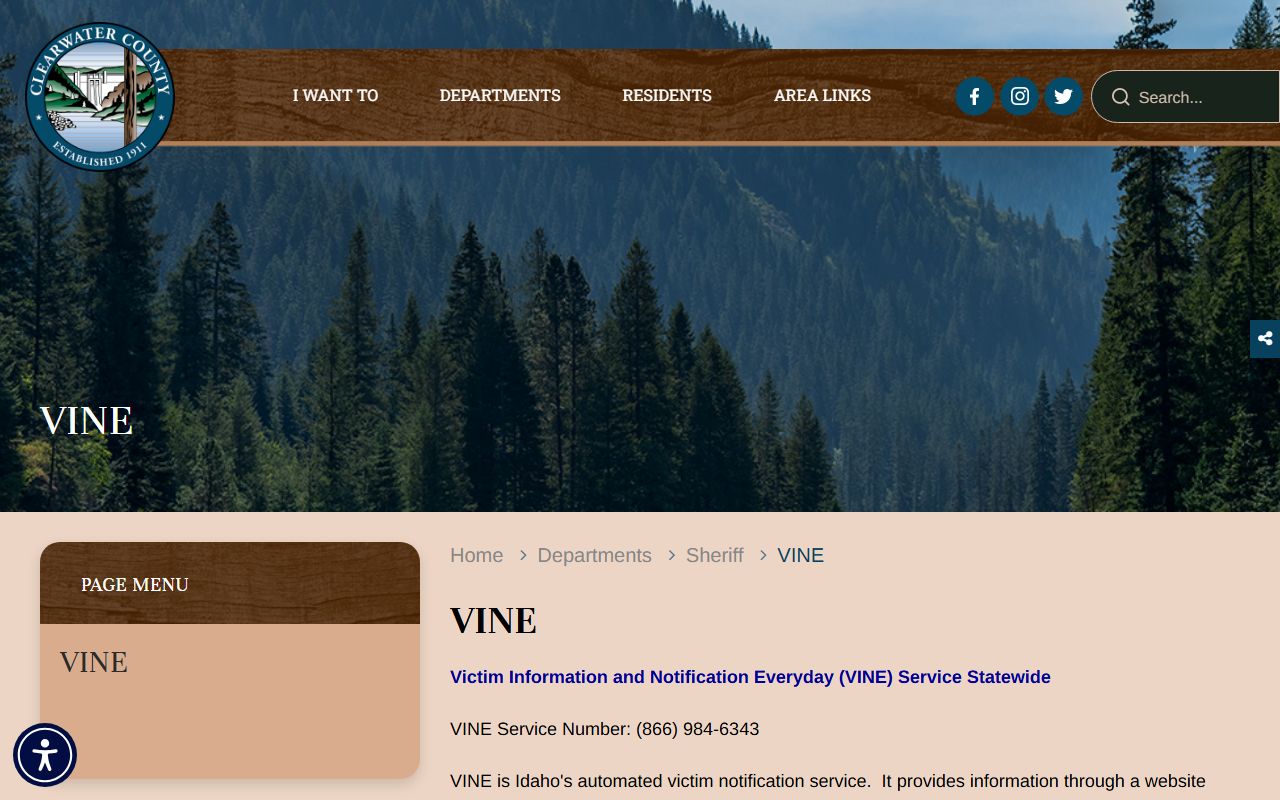
Use VINE for custody notification and iCourt or the clerk for court charge status, since the two systems answer different questions.
Clearwater County Charge Codes
Charge entries can cite an Idaho statute, an offense name, a count number, and a level such as felony, misdemeanor, or infraction. Traffic cases can also begin as citations, while serious driving crimes may become criminal cases. The court record may show fines, restitution, bond, court costs, probation conditions, and warrant events when they are part of the public case file.
Idaho public access comes from more than one rule set. Judicial records are governed by Idaho court access rules, including Idaho Court Administrative Rule 32. County agency records, such as some sheriff administrative records, are handled under Idaho's Public Records Act, including Idaho Code 74-102, Idaho Code 74-103, and Idaho Code 74-105.
Restricted Clearwater County Arrest Records
Not every arrest, charge, or court event is public. Juvenile proceedings, sealed criminal filings, sealed warrants, adoption records, mental-health materials, protected addresses, financial account numbers, minor names, medical details, and some law-enforcement-sensitive records can be withheld or redacted. A sealed case may show limited public metadata or may not appear in ordinary public search at all.
Idaho Code 19-2604 can allow some defendants who satisfy sentence or probation terms to ask for dismissal and relief from certain penalties, but it is not a universal erasure rule. A person seeking relief for a Clearwater County case should identify the exact case number, disposition, sentence, and statutory basis, then work through the court where the case was filed. Law-enforcement and court access can remain broader than public access even after public search visibility changes.
Important: Arrest and charge records should not be used for FCRA-regulated screening without a lawful consumer-reporting process.