
Clearwater County Court Dockets
A court docket is a chronological record of case events. In Clearwater County, a docket may show the case number, court location, case type, filing date, party names where public, hearings, notices, orders, pleas, dispositions, sentencing, payment events, and appeal notices. It is built as the case moves through Idaho's court system.
A docket helps a reader see movement. It does not always give the full document. A docket entry may say that a motion was filed, an order was entered, or a hearing was held, but the text of the motion, signed order, exhibit, affidavit, transcript, or sealed attachment may not be viewable in public search. For complete files, use the broader Clearwater County court records process and the Clerk of the District Court.
The public exemptions image assigned to this docket page comes from Idaho Code section 74-105, which matters when docket entries touch restricted or sensitive records.
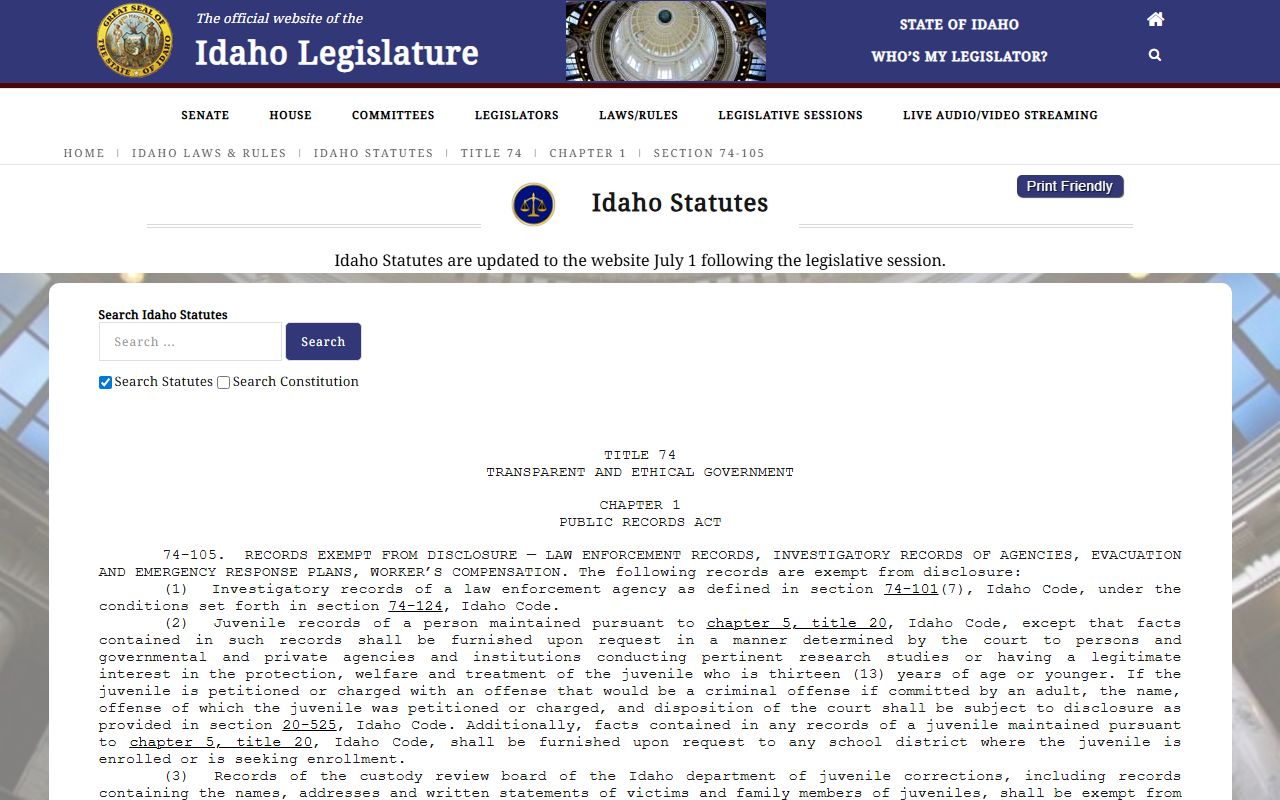
That source is not a docket calendar by itself, but it explains why some docket details are withheld, redacted, or absent from public access.
Find Clearwater County Dockets Online
The main online docket channel is the Idaho iCourt Portal / Odyssey public access system. It covers public District Court and Magistrate Division case information statewide, including Clearwater County cases when public access is allowed. The county research did not locate a separate local docket calendar website for Clearwater County, so iCourt plus clerk confirmation is the practical search path.
- Open iCourt and choose a public search view, hearing search, or case-number search if the portal offers separate tabs.
- Search by case number when known. It is the best way to avoid similar names in statewide results.
- Search by party name if the case number is unknown, then narrow by Clearwater County, Orofino, or Second Judicial District filters when available.
- Open the case result and review docket entries for filing dates, event types, hearing settings, status, and disposition.
- Call or visit the Clerk of the District Court when a hearing date affects travel, a subpoena, a warrant, or a filing deadline.
The Idaho Courts online services page is also useful for statewide court tools such as payments, e-filing, guide-and-file resources, protection-order tools, and jury links, but iCourt remains the public case and docket search channel identified in the research.
Clearwater County Docket Entry Fields
The research file did not locate a live Clearwater sample docket because portal access was restricted during research, but the court-record inventory lists the common public docket fields. These fields help distinguish a brief docket entry from the underlying case document.
| Field | What It Shows |
|---|---|
| Entry date | The date the court entered or posted the docket event. |
| Event type | Complaint filed, summons issued, arraignment, motion filed, hearing held, order entered, judgment, sentencing, or notice of appeal. |
| Case number | The court identifier used to request copies and confirm hearing details. |
| Party / role | Public party names and roles such as plaintiff, defendant, petitioner, respondent, or state. |
| Hearing date | The scheduled date and time for a public hearing, when available. |
| Judicial officer | The assigned judge or magistrate for a hearing or disposition when shown. |
| Status or result | Open, pending, disposed, closed, stayed, transferred, warrant, dismissed, guilty, not guilty, or other event status. |
| Document availability | Whether a public image is available, unavailable, redacted, or obtainable only through the clerk. |
Clearwater County Hearing Dockets
Clearwater County belongs to Idaho's Second Judicial District. The Orofino courthouse is local, while many administrative resources and docket-search tools are statewide or district-wide. District judges and magistrate judges both produce docket activity, but they handle different kinds of cases.
District Court dockets usually matter most for felony criminal cases after bind-over or indictment, larger civil cases, appeals from magistrate decisions, and other higher-level proceedings. Magistrate Division dockets cover the day-to-day case types many residents search: misdemeanors, traffic infractions, small claims, eviction and landlord-tenant cases, protection orders, probate estates, guardianships, conservatorships, juvenile matters, and preliminary felony appearances.
- District Court: felony, major civil, appeals from magistrate decisions, and other assigned district-level matters.
- Magistrate Division: misdemeanors, traffic, probate, small claims, protection orders, juvenile, guardianship, and preliminary felony proceedings.
- Second Judicial District administration: district-wide resources, judges, specialty court information, and administrative court structure.
- Municipal or local-code matters: routed through the Idaho district and magistrate court system where applicable.
The criminal-history statute image assigned to this docket page comes from Idaho Code section 67-3004, which is relevant when a criminal docket is confused with a criminal-history record.
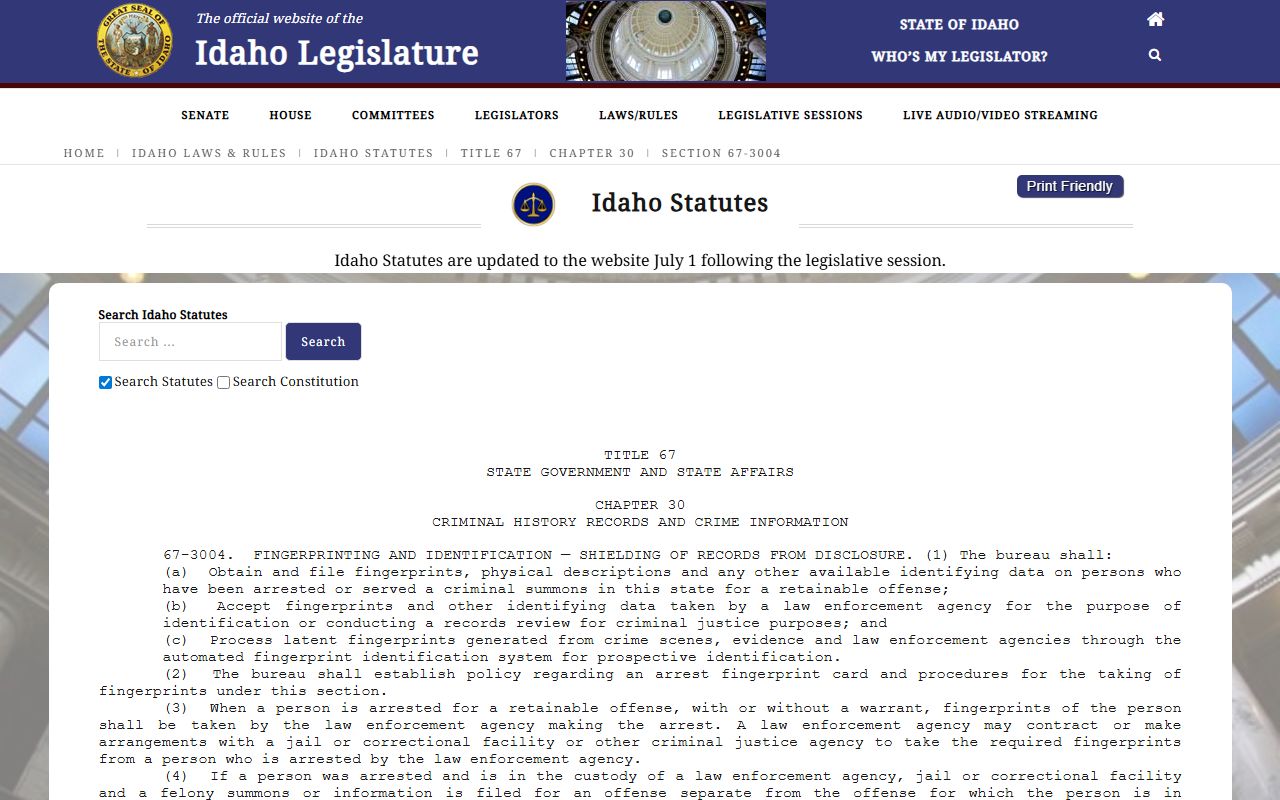
A criminal docket is a court timeline for a case. A criminal-history record is a separate state dissemination subject with different rules and sources.
Docket vs Full Case Record
A docket is the case timeline. The full case record is the larger file behind that timeline. For a Clearwater County criminal case, the docket may show an arraignment, plea, motion, disposition, or sentencing event, while the case record may include the charging document, plea form, written order, sentencing order, warrant, and financial obligations. Civil and family cases work the same way: the docket lists activity, while the case file holds the papers.
| Point | Docket | Full Case Record |
|---|---|---|
| Format | Chronological list of entries and hearings. | Pleadings, motions, orders, judgments, notices, and other filed documents. |
| Best use | Track case progress and hearing settings. | Review the substance of filings or obtain certified documents. |
| Online access | Often visible as public metadata in iCourt. | May require clerk request, copy fee, certification, or court permission. |
| Limits | May omit sealed, redacted, juvenile, or protected details. | May contain restricted documents that are not public. |
Read Clearwater County Dockets
Read docket entries in date order. A case can begin with a complaint, petition, citation, or other opening filing. Later entries may show summons, service, answer, motion, hearing, continuance, order, judgment, plea, disposition, sentencing, payment, warrant, or notice of appeal. A continuance means a hearing or deadline was postponed. A disposition is the final outcome of a charge or claim. A judgment is the court's final decision or enforceable order.
In criminal and traffic cases, the docket may show bond events, failure-to-appear notices, warrant status, fines, costs, restitution, and payment events. In family and protection-order cases, docket lines can be public while addresses, child details, financial records, and sensitive allegations are redacted or restricted. Juvenile matters should not be expected in ordinary public search.
Note: A docket entry proves that an event was recorded, but it may not reveal the full document text.
Missing Clearwater County Docket Items
A missing docket item is not always an error. Idaho court rules, sealing orders, and confidentiality statutes can restrict juvenile records, adoption matters, mental-health proceedings, sealed criminal filings, sealed warrants, protected addresses, minor names, medical details, financial account numbers, and some protection-order information. Public iCourt access may show only limited metadata or nothing at all for restricted matters.
Post-sentence relief can also affect how a criminal case appears in public systems. Idaho Code section 19-2604 provides a dismissal and relief path for some qualifying defendants after sentence or probation conditions are satisfied, but the research warns against calling every relief result an expungement. The court record may still have access limits that differ from law-enforcement or agency access.
The dismissal and sentence-relief image assigned to this page comes from Idaho Code section 19-2604.
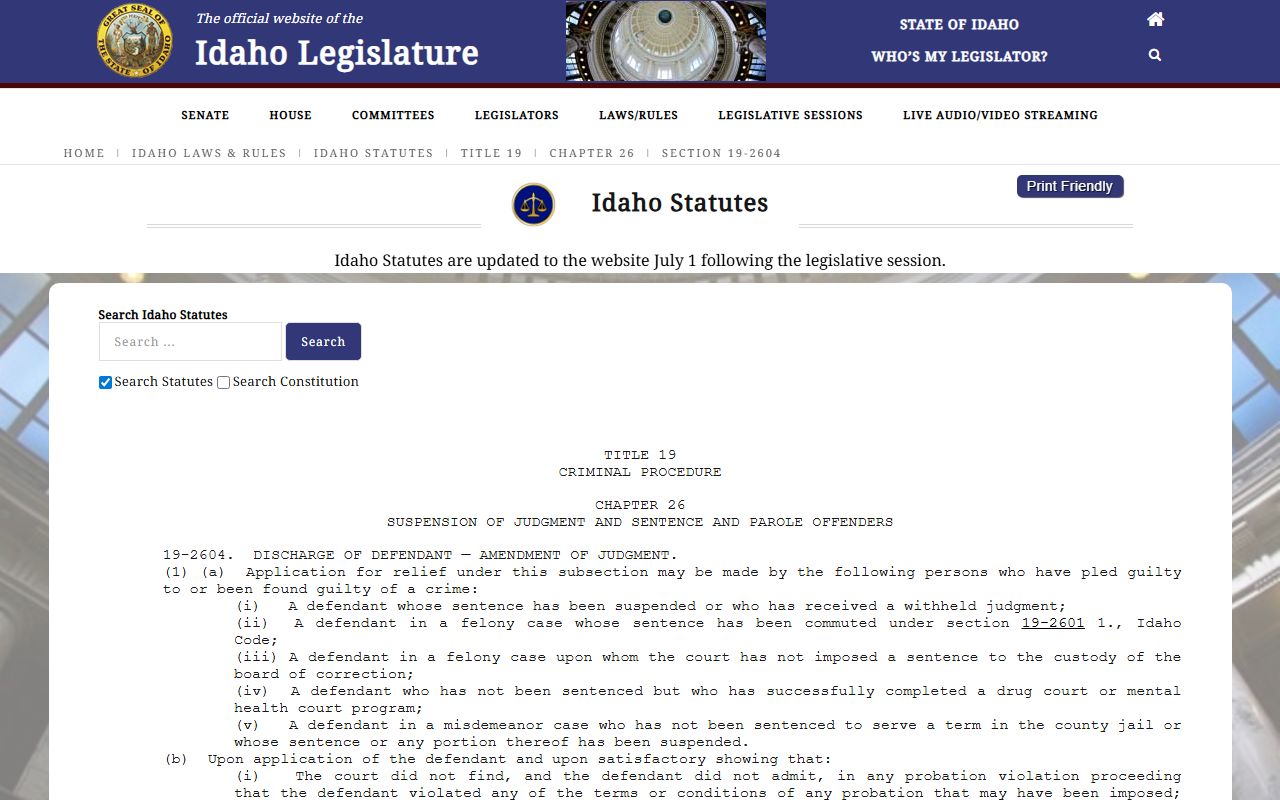
That source helps explain why a docket outcome should be read closely before treating a charge, conviction, dismissal, or relief entry as the same thing.
Confirm Clearwater County Hearings
Hearing dates should be confirmed when attendance matters. Online docket information can change after a continuance, judge assignment, warrant event, or filing update. For travel, subpoenas, bond conditions, payment deadlines, or appearance questions, contact the Clerk of the District Court through the Clearwater County courthouse rather than relying only on a saved screenshot.
Use the case number, party name, hearing date, and case type when calling or visiting. The research did not locate a verified courtroom-specific Zoom rule, parking rule, or direct phone extension, so the safest instruction is to confirm current hearing, access, and accommodation details with the clerk before appearing.
Confirmation also matters when a docket entry appears incomplete. A public search result may lag behind a recent filing, omit a sealed attachment, or show only a brief event label. The clerk can explain whether the visible entry is the latest public docket event, whether a certified copy must be requested, and whether a hearing has been reset or remains on the calendar.
Clearwater County Clerk of the District Court
150 Michigan Avenue
Orofino, ID 83544
Confirm current phone on the official clerk page
Confirm hours before visiting